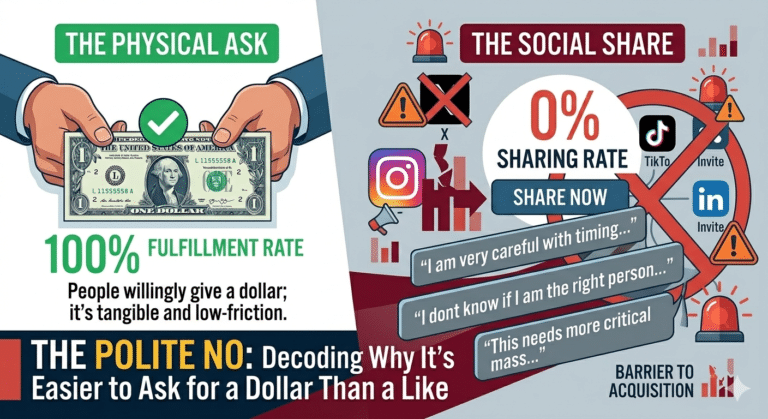
The Enthusiasm Gap: When 45 Minutes Leads to Zero Clicks
In these early days of canigetadollar.com, we aren’t just blasting links into the void. We took a human-centric approach. We sat down with business people, influencers, and community leaders for 30 to 45 minutes at a time. We explained the concept: the psychology of the dollar, the battle with the banking algorithms, and the creation of a global digital ledger.
The response was almost universal: “This is fascinating. I love this. It’s so unique.”
But then came the “Ask.” We weren’t asking for their money; we were asking for their Social Capital. We asked them to invite friends to the page, share a post about the experiment, or simply message a few people to start a conversation. The “Ask” was small, but the result was a masterclass in the friction of modern social engagement.
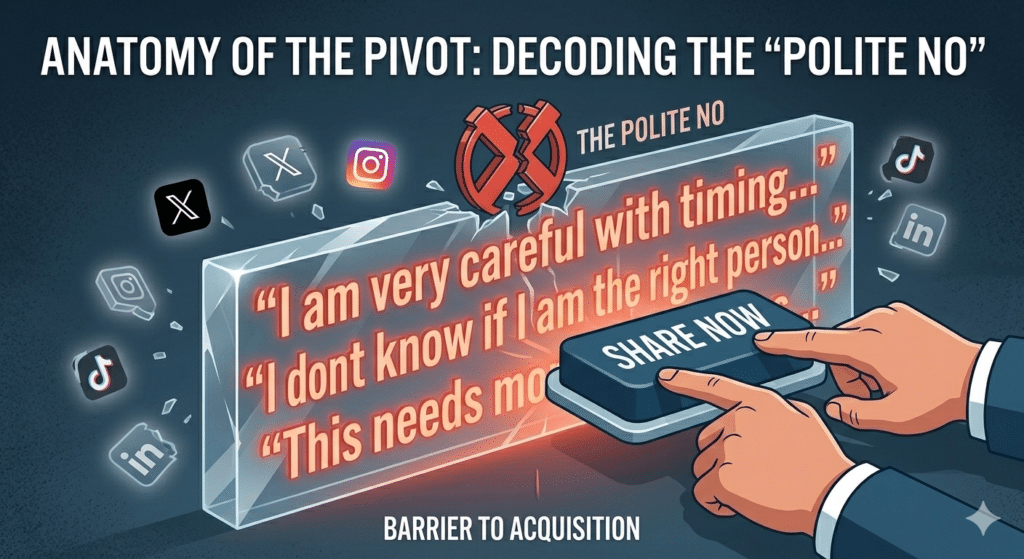
The Anatomy of the Pivot: Decoding the “Polite No”
When the time came to actually hit “Share,” the enthusiastic “Yes” of our 45-minute meetings evolved into a series of highly polished, professional deflections. These are phrases every startup founder and small business owner knows by heart:
- “I am very careful with my timing and who I work with.” (Translation: I don’t want to risk my aesthetic/brand on something unproven.)
- “I don’t know if I am the right person to do this.” (Translation: I don’t want to be the first one to vouch for you.)
- “This needs more critical mass than what I can provide.” (Translation: I’ll share it once it’s already viral.)
Despite the deep dives and the genuine interest expressed in person, the total number of actions taken by these “interested” parties was zero.
The Startup Struggle: The “Critical Mass” Catch-22
This isn’t just a canigetadollar.com problem; it is the universal struggle of the startup. Every small business is told to “build a community” and “leverage their network.” But the network is often a one-way street.
People love to be adjacent to innovation, but they are terrified of being the engine of it. In the startup world, this creates a Catch-22: You can’t get support until you have “critical mass,” but you can’t get critical mass without support. The very people who say they want to help often wait until you no longer need the help before they offer it.
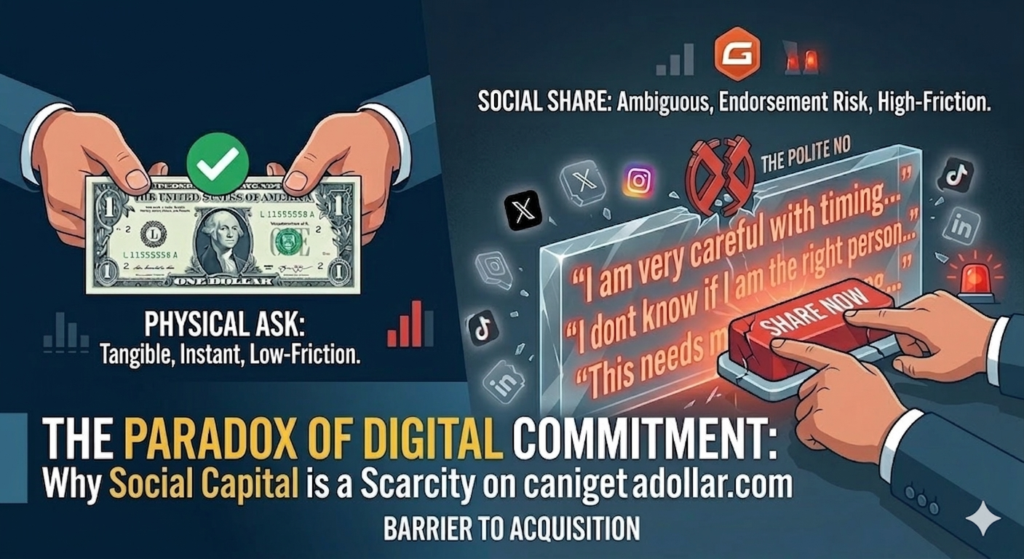
Why Digital Sharing is More Expensive Than a Dollar
This experiment has proven a startling hypothesis: It is easier to get a stranger to give you $1.00 than it is to get a friend to give you a “Share.”
A dollar is a finite, clinical transaction. But a social share is an endorsement of identity. In 2026, people guard their social feeds more fiercely than their bank accounts. Sharing a “Social Experiment” feels risky because it’s “different.” If the experiment fails, the sharer feels they look foolish.
For a small business, this means that “Word of Mouth” isn’t a free marketing tool—it’s the most expensive resource in the world. It requires more than just a good idea; it requires a person willing to put their own reputation on the line for your $1.00 dream.
The Data of Hesitation
As we continue this journey, we are recording these interactions as a primary data set. We are tracking the “Yes-to-Action” ratio.
- Total meetings: 8
- Average meeting length: 40 minutes
- Initial Interest Level: 100%
- Follow-up Action Rate: 0%
This data proves that the “Banking Barrier” isn’t our only hurdle. The “Social Barrier” is just as rigid. People are interested in the project, but they are paralyzed by the prospect of being the “patient zero” for a new idea.